Malaysia e-Invoicing — The Complete 2026 Compliance Guide for SMEs
1. What Is e-Invoicing? Electronic invoicing (e-Invoice) is a digitalised invoicing system mandated by Malaysia's Inland Revenue Board (LHDN, Lembaga Hasil Dal…
1. What Is e-Invoicing?
Electronic invoicing (e-Invoice) is a digitalised invoicing system mandated by Malaysia's Inland Revenue Board (LHDN, Lembaga Hasil Dalam Negeri).
Unlike a traditional PDF invoice or paper receipt, an e-Invoice is a structured electronic document that is validated in real time — or near real time — through LHDN's MyInvois platform. Every invoice submitted must pass system validation before it receives a unique identifier (UUID) and a QR code, at which point it becomes legally recognised.
About the MyInvois Platform
MyInvois (https://myinvois.hasil.gov.my/) is the national centralised platform LHDN built specifically for e-Invoice. Its core functions are:
- Receiving, validating, and storing invoice data submitted by businesses
- Returning real-time validation results (accepted or rejected) together with a unique UUID
- Allowing both buyers and sellers to view, acknowledge, and reject invoices online
- Providing taxpayers with a searchable archive of historical invoices
Businesses can connect to MyInvois in one of three ways (see Section 6): manual entry via the web portal, programmatic API integration, or through a certified middleware or ERP system.
2. Why Is Malaysia Implementing e-Invoicing?
LHDN's push for e-Invoice is not arbitrary. Three key drivers are behind it.
1. Improving Tax Transparency and Closing Revenue Gaps
Malaysia loses significant tax revenue each year through invoice fraud, underreported income, and the shadow economy. By requiring transaction data to be reported to LHDN in real time or near real time, e-Invoice fundamentally narrows the space for off-book transactions.
2. Modernising GST/SST Reconciliation and Audit
Since the abolition of GST in 2018 and the reintroduction of SST, cross-referencing data between LHDN and the Royal Malaysian Customs Department (RMCD) has relied heavily on manual processes. e-Invoice automates cross-matching between supplier declarations and buyer deductions, making audits more efficient and traceable.
3. Aligning with Global Digital Tax Trends
Indonesia, Singapore, the European Union, and India have all mandated e-invoicing or equivalent systems. Malaysia's adoption also signals its commitment to improving the business environment and attracting foreign investment.
The bottom line: e-Invoice is not just a tax authority concern. It will directly change how you issue invoices, manage receivables, and prepare for audits.
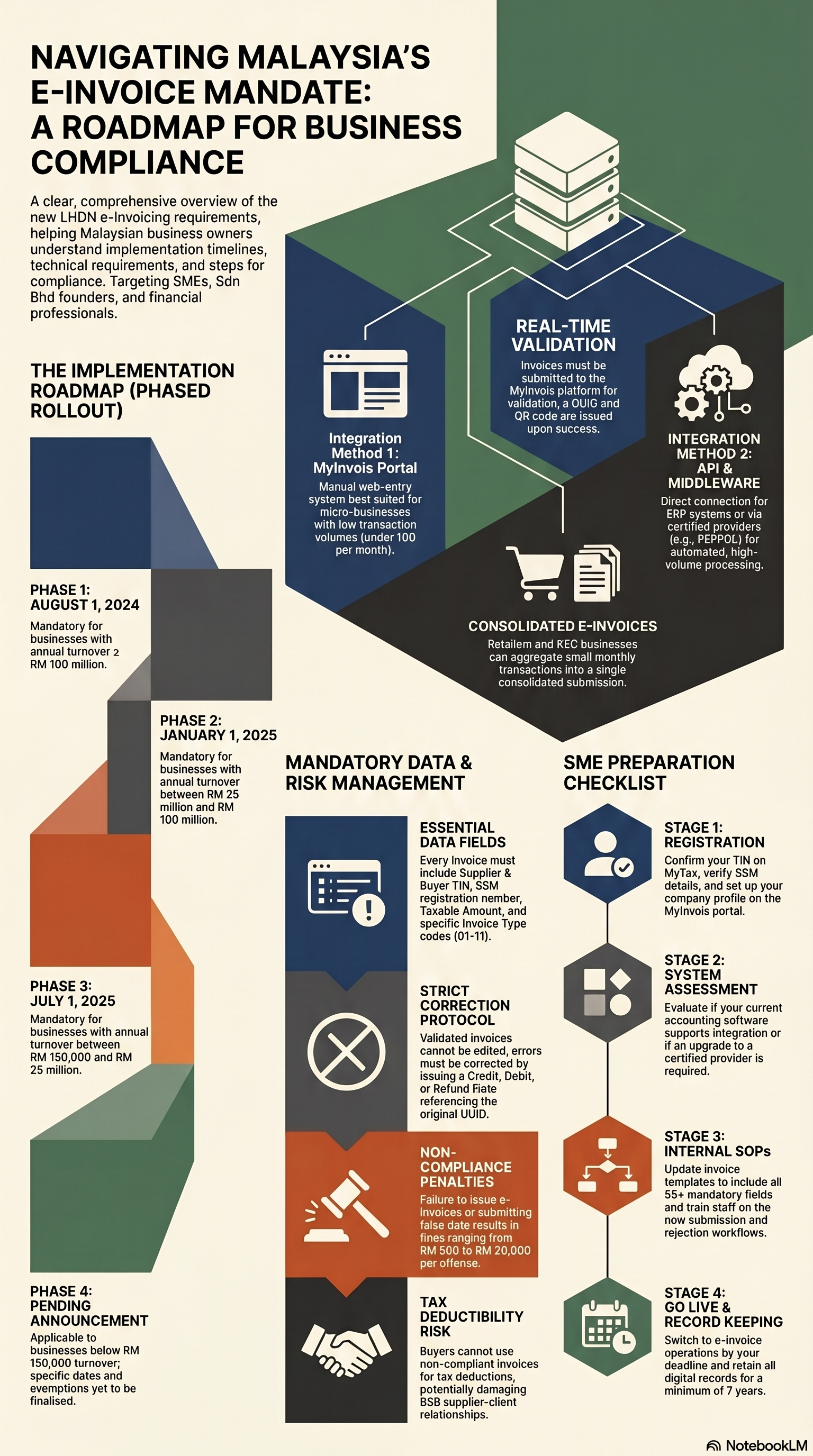
3. Phased Rollout Schedule
LHDN is rolling out e-Invoice in phases based on annual turnover, giving smaller businesses more time to prepare.
Important: As of the date this article was last updated (2026-04-22), LHDN has not issued a final announcement on the effective date or exemption scope for Phase 4. Monitor the LHDN website and the latest edition of the e-Invoice Specific Guideline closely.
How Do You Know Which Phase You Fall Under?
The reference figure is your business's annual turnover for the preceding year of assessment, not registered capital or headcount. For businesses whose financial year does not align with the calendar year, use the most recently completed audited or filed financial year.
4. Who Must Comply? Who Is Exempt?
Entities Required to Comply
Any business entity registered in Malaysia that is required to file income tax or withholding tax with LHDN must implement e-Invoice according to its applicable phase. This includes:
- Private limited companies (Sdn Bhd)
- Enterprises and sole proprietorships
- Partnerships
- Foreign company branches operating in Malaysia
- Limited liability partnerships (LLP)
Exempted Categories
Under the LHDN e-Invoice Guideline (Version 3.2 and subsequent editions), the following transaction types are exempt from e-Invoice requirements:
- Employment income — salary slips and employer-to-employee compensation
- Dividends — distributions from a company to its shareholders
- Government grants and transfer payments
- Certain low-value retail transactions — B2C transactions may use a Consolidated e-Invoice instead (see Section 7)
- Consumer-to-consumer (C2C) transactions
Note: Exemptions apply to specific transaction types, not to specific company types. Even if your annual turnover falls below the current threshold, if you are already issuing B2B commercial invoices, it is good practice to adopt the e-Invoice format — particularly as larger buyers may require it for their own tax deduction purposes.
5. Mandatory Fields
Every compliant e-Invoice must contain the following core fields. Missing or incorrectly formatted fields will cause MyInvois to reject the submission.
Supplier Information
- TIN (Tax Identification Number) — Supplier's LHDN TIN (e.g. C12345678900)
- SSM registration number — Company Registration No. or Business Registration No.
- Company name — Must match SSM / LHDN records exactly
- Address — Full registered address
Buyer Information
- TIN — Buyer's TIN (mandatory for B2B; for B2C, use the system code EI00000000010)
- SSM number / identity card number — Depending on buyer type
- Buyer name and address
Invoice Details
- Invoice type code — 01 = Invoice, 02 = Credit Note, 03 = Debit Note, 04 = Refund Note, 11 = Self-Billed Invoice
- Invoice date and time — ISO 8601 format
- Currency code — MYR or other (exchange rate must be stated if not MYR)
- Line items — Product/service description, quantity, unit price, subtotal
- Tax type and rate — SST (Sales Tax 5%/10%, Service Tax 8%) or 0% (exempt)
- Taxable amount / tax amount / total amount — Each must be itemised separately
6. Technical Integration Options
LHDN offers three pathways for businesses to connect to MyInvois.
Option 1: Manual Entry via the MyInvois Web Portal
Best suited for: Micro-businesses with low transaction volumes (fewer than 100 invoices per month) and no existing ERP system.
Log in to the MyInvois web interface and enter invoice details manually. This is straightforward to set up but is inefficient and error-prone at scale — it is not recommended as a long-term solution.
Option 2: Direct API Integration
Best suited for: Medium and larger businesses with a technical team and an existing ERP or billing system.
LHDN provides a standard REST API (documented at https://sdk.myinvois.hasil.gov.my/), which allows businesses to connect their existing systems directly to MyInvois for automated invoice submission, status queries, and document management.
Option 3: Middleware or Certified Service Provider (including PEPPOL)
Best suited for: SMEs that prefer not to build their own API integration and would rather work through their existing accounting software.
LHDN recognises service providers that comply with the PEPPOL (Pan-European Public Procurement On-Line) standard. Major local accounting software providers — including SQL Account, AutoCount, and Financio — have been progressively releasing MyInvois integration modules. Upgrading your existing software is often the most cost-effective path to compliance.
Muchen's recommendation: For most Sdn Bhd owners, choosing a local accounting software that already integrates with MyInvois is the highest-value option. Muchen can help you evaluate your current system and recommend the right fit.
7. Consolidated e-Invoices, Self-Billed e-Invoices, and Credit/Debit Notes
Consolidated e-Invoice
For B2C (business-to-consumer) transactions, LHDN allows businesses to aggregate multiple retail transactions over a period (typically one month) into a single consolidated submission, rather than issuing individual e-Invoices per transaction.
Applicable for: Retailers, food and beverage operators, and service businesses collecting small consumer payments daily.
Limitation: The buyer TIN on a Consolidated e-Invoice uses the system code EI00000000010 and cannot be used by buyers for tax deduction purposes.
Self-Billed e-Invoice
In certain situations, the buyer is required to issue the invoice on behalf of the seller. Common scenarios include:
- Purchasing goods or services from an individual (non-registered vendor), such as agent commissions or freelancer fees
- Imported services (cross-border payments)
- Certain categories of government procurement
The invoice type code for a Self-Billed e-Invoice is 11, and both the supplier and buyer fields reflect the buyer's information.
Electronic Credit Notes, Debit Notes, and Refund Notes
Once an original invoice has been submitted and validated, it cannot be directly amended or deleted. The following documents must be issued instead:
- Credit Note — to reduce the original invoice amount (returns, discounts)
- Debit Note — to increase the original invoice amount (additional charges)
- Refund Note — for cash refunds
Each of these must reference the UUID of the original invoice in MyInvois to maintain a full audit trail.
8. Consequences of Non-Compliance
Compliance is not optional. The Income Tax Act 1967 (ITA), Section 120 sets out the following penalties:
- Failure to issue e-Invoices as required — a fine of RM 200 to RM 20,000 per offence
- Submitting false or incomplete invoice data — same range; serious cases may attract criminal prosecution
- Refusing to cooperate with an LHDN audit — additional penalties, potentially including licence suspension
Downstream risks: If a buyer receives a non-compliant invoice, the related business expense may not be deductible for tax purposes — which can affect your client relationships. If your business is already under an LHDN audit, non-compliant invoice records can be used as grounds for aggravated penalties.
9. SME Practical Compliance Checklist
Stage 1: Verify Your Identity and Register
- Confirm your company's TIN via the MyTax portal (https://mytax.hasil.gov.my/) — apply if you do not yet have one
- Verify your SSM registration number and ensure your company details match your LHDN records
- Complete company registration on MyInvois, designate an authorised administrator, and set up your company profile
- Collect TINs from your key suppliers and customers in advance (buyer TIN is mandatory for B2B invoices)
Stage 2: Assess and Select Your System
- Review whether your existing accounting or ERP system already supports MyInvois integration
- Determine your integration method: manual portal / direct API / certified middleware
- Estimate your average monthly invoice volume to prioritise automation needs
- Test in the MyInvois Sandbox environment and validate before going live
Stage 3: Internal Processes and Training
- Designate a finance lead or accountant to own the MyInvois workflow
- Update your invoice templates to include all mandatory fields (especially TIN, SSM number, and invoice type code)
- Establish a resubmission SOP and customer notification process for rejected invoices
- Train sales and administrative staff involved in the invoicing process
Stage 4: Go Live and Ongoing Monitoring
- Complete all preparation before your applicable effective date and switch to e-Invoice operations
- Run monthly compliance checks: review submission volumes, rejection rates, and unresolved invoices
- Retain invoice records for a minimum of 7 years as required under the ITA
10. Frequently Asked Questions
Q1: I run a micro-business with annual turnover below RM 150,000. What do I need to do now?
Based on current LHDN announcements, businesses with annual turnover below RM 150,000 fall under Phase 4, and the specific effective date has not yet been finalised. However, we recommend using the time now to verify your TIN and assess your accounting system — last-minute preparation is costly. Proactive compliance also builds trust with larger B2B customers who need valid invoices for their own deductions.
Q2: Can I just use my existing accounting software?
It depends on the version. Most major Malaysian accounting software providers have released or are in the process of releasing MyInvois integration modules, but you may need to upgrade to a supported version. Contact your software vendor directly to confirm their roadmap and any associated costs.
Q3: What happens if MyInvois rejects my invoice?
MyInvois returns a specific error code and description. Common causes include incorrectly formatted TINs, missing mandatory fields, and buyer TINs that are not registered with LHDN. Correct the errors and resubmit. A rejected invoice has no legal standing — do not send it to your buyer before it passes validation.
Q4: My customers are individual consumers. Do I need to issue a separate e-Invoice for each transaction?
No. B2C retail transactions can use a Consolidated e-Invoice, aggregating all consumer receipts within a calendar month into a single submission. This significantly reduces the operational burden for consumer-facing businesses.
Q5: I have multiple companies. Does each one need to comply separately?
Yes. e-Invoice compliance obligations apply at the legal entity level. Each company must independently register on MyInvois and submit its own invoices. Dormant companies with no revenue generally do not need to issue e-Invoices, but confirm this with your tax adviser.
11. How Muchen Can Help
e-Invoicing compliance is manageable — but there are real pitfalls, particularly around TIN verification, system selection, and determining when Self-Billed invoices apply. Getting these wrong early means reworking your entire setup.
Muchen Advisory provides:
- MyInvois registration and initial configuration — we walk you through portal registration, company profile setup, and authorised user assignment
- Existing system compliance assessment — we evaluate whether your current software is ready and advise on the upgrade path
- Invoice template compliance review — we check your existing templates against the mandatory field requirements
- Consolidated and Self-Billed invoice scenario guidance — tailored advice based on your specific business model
- Ongoing monthly compliance monitoring (optional) — as your outsourced finance team, we track your submission status on an ongoing basis
If you have any questions about e-Invoice compliance, reach out to the Muchen team directly. Most of our clients are Sdn Bhd founders in exactly your position — we speak in plain language, not LHDN document-speak.
For any tax-related decisions, always confirm with your formally engaged tax agent or accountant. This article is for informational purposes only and does not constitute formal tax or legal advice.
References
- LHDN official website: https://www.hasil.gov.my/
- MyInvois platform: https://myinvois.hasil.gov.my/
- MyInvois SDK / API documentation: https://sdk.myinvois.hasil.gov.my/
- e-Invoice Guideline (LHDN): https://www.hasil.gov.my/en/e-invoice/
- Income Tax Act 1967, Section 120 (penalty provisions)
- LHDN MyTax portal: https://mytax.hasil.gov.my/
Muchen Corporate Services Sdn. Bhd. | All rights reserved. Feel free to share — please credit Muchen Corporate Services Sdn. Bhd. if you reproduce any part of this article.
Need a real-world hand?
Our MAICSA-credentialled team replies within one business day — WhatsApp is fastest.