From Zero to Sdn Bhd — A 7-Step Founder's Roadmap (Malaysia 2026)
You registered the company. Now what? Most Malaysian founders spend weeks — sometimes months — getting their Sdn Bhd set up, and then freeze. The SSM certifica…
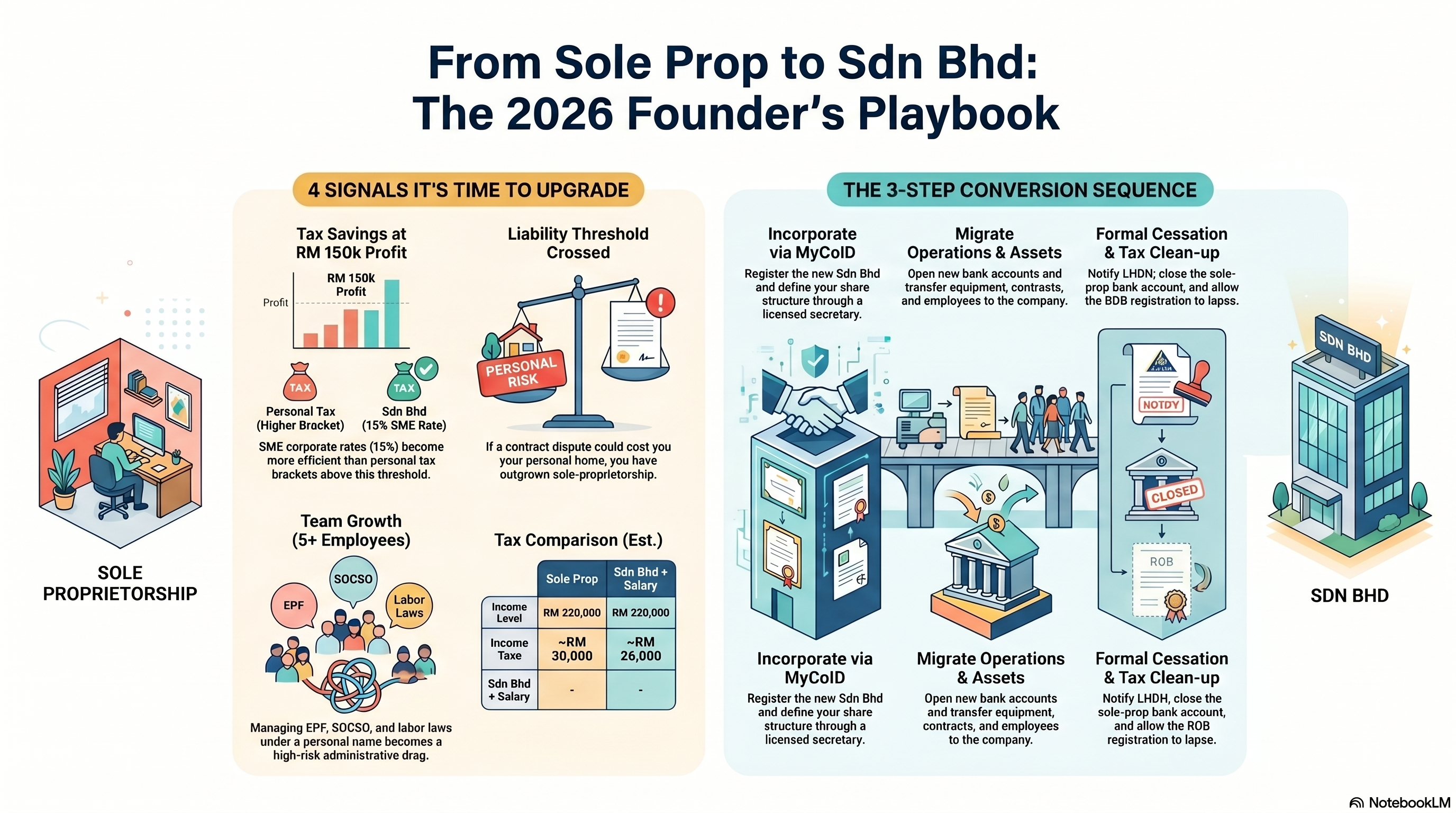
You registered the company. Now what?
Most Malaysian founders spend weeks — sometimes months — getting their Sdn Bhd set up, and then freeze. The SSM certificate is framed, the WhatsApp status updated, the family group chat congratulated. And then... nothing moves.
The company sits there. Silent. Racking up invisible obligations that nobody told you about.
Here is the uncomfortable truth: incorporation is Step 2, not Step 1. And most founders skip Step 1 entirely.
This roadmap walks you through all seven steps — from validating your idea before you spend a single ringgit, to understanding your first tax estimate. It is built for Malaysian founders who incorporated in the last three years, or who are about to.
Let's go.
Step 1: Validate Your ICP and Offer Before You Touch SSM
The most expensive mistake a Malaysian founder makes is incorporating first and validating later.
SSM incorporation costs around RM1,000–RM1,500 when you factor in the government fee, professional cosec charges, and your first set of statutory documents. That is not a huge sum — but it is not the real cost. The real cost is the compliance clock that starts ticking the moment your company number is issued.
So before you open a single form, answer these four questions:
- Who exactly is your customer? Not "SME owners" — be specific. Which industry, which company size, which pain, which budget cycle?
- What do they pay for today? If nobody is paying for a version of your solution right now, that is a signal worth taking seriously.
- Can you get your first paying client within 60 days of launch? If the answer requires a six-month sales cycle, your cash runway assumptions need adjusting.
- What does your break-even look like? Fixed costs ÷ (average price − variable cost per unit) = the number of clients you need before you stop losing money every month.
You do not need a business plan document for this. You need honest answers on one page.
The best founders we meet have one thing in common: they charged someone before they had a company.
Common mistake: Incorporating an Sdn Bhd to "look more professional" before you have even had one sales conversation. The professionalism that closes deals is your offer and your track record — not your company number.
Step 2: Incorporate Your Sdn Bhd Properly
Once you have validated demand — even one warm prospect who said "yes, I would pay for that" — you are ready to incorporate.
Here is what the process actually looks like in 2026:
- Choose your company name and check availability on the SSM MyCoID portal.
- Appoint a Company Secretary (cosec) — this is a legal requirement under the Companies Act 2016 (CA 2016). Your cosec files the incorporation documents with SSM and remains your statutory compliance officer for as long as the company exists.
- Decide on your share structure — who owns what percentage, and what is the paid-up capital? Most early-stage founders start with RM1 paid-up per share and 100 or 1,000 shares issued.
- Register your business address — this is your registered office address (must be a physical address in Malaysia) and your business address, which may differ.
- Appoint your first director(s) — at least one director must be a Malaysian citizen or permanent resident ordinarily resident in Malaysia (CA 2016 s.196).
SSM processes most incorporations within one to three business days via the MyCoID portal.
Common mistake: Skipping the cosec appointment or using a friend "for now." Your cosec is not optional — failing to appoint one is a statutory offence. More practically, a good cosec keeps your compliance calendar running so you are not blindsided by deadlines.
Muchen helps here: Muchen Corp Services handles the full incorporation workflow — name search, document preparation, cosec appointment, registered office — as a bundled package.
Step 3: Open Your Business Bank Account
Your Sdn Bhd is a separate legal person. Its money must live separately from yours.
Opening a business current account in Malaysia typically requires:
- Certified copy of the Certificate of Incorporation
- Copy of the Constitution (or the standard CA 2016 constitution if you adopted it)
- Board resolution authorising the account opening (your cosec prepares this)
- MyKad copies of all directors and authorised signatories
- Initial deposit (varies by bank — typically RM500–RM5,000)
Most Malaysian banks (Maybank, CIMB, RHB, Public Bank, Hong Leong) offer SME current accounts. Processing takes one to three weeks once documents are submitted.
Common mistake: Continuing to receive client payments into a personal account after incorporation. This muddies your accounts, creates transfer pricing risk between you and the company, and makes your bookkeeper's life significantly harder when year-end comes.
Keep it clean from Day 1. Reconciling six months of mixed transactions costs more in accounting fees than the bank charges ever would.
Step 4: Land Your First Paying Client
This is the step that actually matters.
Everything before this is overhead. The company exists. The bank account is open. Now the business has to earn its keep.
A few things that Malaysian B2B founders often miss at this stage:
- Issue a proper invoice. Your invoice must include your company name, company registration number, invoice date, invoice number, description of services, amount, and payment terms. If you are subject to e-invoicing requirements, you will also need to comply with LHDN's e-Invoice mandate (thresholds and timelines are staggered by annual turnover).
- Collect a deposit. For service businesses, 30–50% upfront is standard and healthy. It validates client commitment and protects your cash flow.
- Sign an engagement letter or service agreement. Even a simple one-page letter of engagement protects both parties. Your cosec or a lawyer can prepare a standard template.
- Record the revenue properly. Even if you are not yet doing formal monthly accounts, keep a simple spreadsheet: date, client, invoice number, amount, payment received date. Your accountant will thank you.
Common mistake: Treating the first client as an exception and doing everything informally — verbal agreement, personal transfer, no receipt. That client becomes your template. Set the right template from the start.
Step 5: Register with LHDN and Evaluate Your SST Position
Once money is coming in, your tax obligations kick in. There are two things to sort:
LHDN (Income Tax) Registration
Your Sdn Bhd must register with Lembaga Hasil Dalam Negeri (LHDN) as a taxpayer. This is done online via MyTax (mytax.hasil.gov.my). Once registered, your company will be assigned an income tax file number.
For your first year of assessment, your company must submit Form CP204 — the estimated tax payable for the year — not later than 30 days before the start of the basis period (under the Income Tax Act 1967, s.107C). For most companies with a 31 December financial year-end, this means CP204 is due by 1 December of the preceding year (or in the first year, 30 days before the first accounting period begins).
CP204 is paid in monthly instalments across 12 months. You can revise your estimate upward or downward via Form CP204A in the 6th and 9th month. If your actual tax payable ends up exceeding your CP204 estimate by more than 30%, a 10% penalty applies on the differential (ITA 1967, s.107C(10)) — so it pays to estimate conservatively rather than optimistically.
Your annual corporate income tax return is filed on Form C, due within 7 months of your financial year-end (ITA 1967, s.77A). If you e-file via MyTax, you get one additional month — effectively 8 months.
SST (Sales and Service Tax) Evaluation
Malaysia does not have GST as of 2026. The current indirect tax regime is the Sales and Service Tax (SST).
- Service Tax applies to prescribed taxable services at 8% (certain categories at 6%). If your business provides taxable services and your annual turnover exceeds RM500,000, you are required to register for service tax.
- Sales Tax applies to manufacturers of taxable goods — less likely to apply to typical service-based SMEs.
Evaluate your SST position early. If you are approaching the threshold, factor the 8% into your pricing now rather than absorbing it later.
Common mistake: Founders who assume they "don't need to worry about tax yet" because the company is small. LHDN registration and CP204 filing obligations exist from your first year of assessment regardless of whether the company is profitable.
Muchen helps here: Muchen Corp Services assists with LHDN registration, CP204 preparation, and ongoing tax estimate management — so you are not estimating blind.
Step 6: Set Up Your Cosec, AGM Calendar, and Statutory Registers
This is the step that 90% of early-stage founders ignore — until SSM sends them a reminder, or worse, a penalty notice.
Here is what your Sdn Bhd is legally required to maintain:
Annual Return
Every company must lodge an Annual Return with SSM within 30 days of the anniversary of its incorporation date (CA 2016, s.68(1)). The Annual Return is filed via the MBRS (Malaysian Business Reporting System) portal and must include updated particulars of directors, secretaries, shareholders, and the registered office.
Missing this deadline carries a fine of up to RM50,000 per director, plus continuing fines of up to RM1,000 per day (CA 2016, s.68(8)). Late lodgement fees also apply: RM50 if filed more than 7 days but within 3 months late; RM100 if more than 3 months late.
XiaoMing's data shows that a significant proportion of early-stage founders do not know this deadline exists until they receive an SSM notice.
Financial Statements
Your company must prepare annual financial statements (profit and loss account, balance sheet, and notes). Under SSM Practice Directive 10/2024 (effective for financial periods beginning on or after 1 January 2025), companies meeting two of three criteria — annual revenue ≤ RM3 million, total assets ≤ RM3 million, or ≤ 30 employees — may qualify for audit exemption under CA 2016, s.267(2). Even audit-exempt companies must still prepare and circulate unaudited financial statements under s.258 and s.259, and lodge them with SSM within 30 days of circulation.
Statutory Registers
Your cosec must maintain the following statutory registers at the registered office or MBRS:
- Register of Members (CA 2016, s.245)
- Register of Directors
- Register of Substantial Shareholders
- Register of Debenture Holders (if applicable)
- Minutes of Board Meetings and Members' Meetings
Common mistake: Assuming the cosec handles everything without being told anything. Your cosec needs to know about changes — new directors, share transfers, address changes, new bank accounts — so they can update the statutory records in time. They are not mind-readers. Keep the communication loop open.
Muchen helps here: Muchen Corp Services provides full cosec services including annual return filing, statutory register maintenance, and minutes preparation — keeping your compliance calendar on track.
Step 7: Calculate Your First Profit and Tax Estimate
Congratulations — you made money. Now let us make sure you keep the right amount of it.
Your first mini P&L
At the end of each month (or at least each quarter), run a simple profit and loss:
Total Revenue
− Cost of Sales (direct costs to deliver your service)
= Gross Profit

− Operating Expenses (salaries, rent, software, marketing, professional fees)
= Net Profit Before Tax

− Estimated Tax
= Net Profit After Tax
Corporate tax rate for SMEs (2026)
For Sdn Bhd companies with a paid-up capital of RM2.5 million or less (and not more than 20% owned by a related company), the Malaysian SME preferential corporate tax rate is:
- 15% on the first RM150,000 of chargeable income
- 17% on the next RM450,000 (i.e., up to RM600,000)
- 24% on the balance above RM600,000
(Standard corporate rate for non-qualifying companies is 24%.)
The golden rule of cash flow
Profit and cash are not the same thing. A company can be profitable on paper and still run out of cash — because clients pay late, because tax instalments are due, because you over-invested in inventory or equipment.
Keep 3 to 6 months of operating expenses in your business account as a buffer. When you reach that buffer, you can start paying yourself a proper salary and reinvesting surplus into growth.
Common mistake: Treating the bank balance as profit. Invoice your clients promptly, collect payment on time, and remember that your CP204 instalments are going out every month regardless of whether your clients have paid you.
Muchen helps here: Muchen Advisory provides monthly bookkeeping and management accounts so you always know where you stand — before the year-end tax bill surprises you.
Frequently Asked Questions
Do I need a company secretary from Day 1?
Yes. Under CA 2016, every Sdn Bhd must have a licensed company secretary at all times. There is no grace period.
Can I use my home address as the registered office?
Yes, as long as it is a Malaysian address. Some founders prefer a separate registered office address (many cosec firms offer this) to keep personal and business correspondence separate.
When exactly do I need to file CP204?
For a new company, CP204 must be submitted not later than 3 months after the commencement of the company's first basis period (there is a special rule for the first year — confirm with your tax agent as the exact treatment depends on your financial year-end). For subsequent years, it is due 30 days before the start of the basis period.
Do I need to be GST-registered?
GST was abolished in Malaysia in 2018. You are not required to register for GST. Evaluate your SST position (Service Tax threshold: RM500,000 annual turnover for prescribed services).
What happens if I miss my annual return?
You face fines of up to RM50,000 per director plus daily continuing fines. Late lodgement fees also apply. File as soon as possible and do not let it accumulate.
I am a sole proprietor — does any of this apply to me?
Sole proprietorships and partnerships are registered under the Registration of Businesses Act 1956, not the Companies Act 2016. The compliance framework is different. If you are considering converting to an Sdn Bhd, speak to a cosec about the process.
The Bottom Line
Starting an Sdn Bhd in Malaysia is not complicated — but it does have moving parts, and the moving parts do not wait for you to be ready.
If you follow this roadmap in order — validate first, incorporate second, open the bank account, land a client, sort your tax registrations, keep your statutory records clean, and track your numbers monthly — you will have built the foundation that most Malaysian SMEs are still scrambling to construct three years in.
The founders who get this right early spend less on professional fees later, sleep better at night, and have cleaner cap tables when investors come knocking.
Need help getting the compliance side right without losing sleep over it? Muchen Corp Services handles incorporation, cosec, annual returns, and tax registration — so you can focus on building the business, not filing the paperwork. Reach out via our website or DM us directly.
Always double-check the specifics with your cosec or tax agent before acting. This article is for general information purposes and does not constitute legal or tax advice.
Need a real-world hand?
Our MAICSA-credentialled team replies within one business day — WhatsApp is fastest.